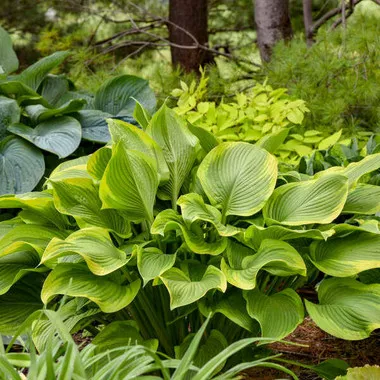
Common Name: Hosta A green-centered sport of the popular ‘Key West’. Leaves are a medium green with a vivid gold margin. Bright filtered shade draws out the most intense gold coloration in the margin. Near white flowers are held well above the foliage on tall scapes in early summer.
Hostas are exceedingly popular perennials in today’s gardens due to their versatility in the landscape. Their subtle colors, tall flower scapes, and broad, coarse leaves fill a niche in garden designs that few other plants can achieve. Their large leaves provide excellent coverage for dying bulb foliage. Hostas also grow well in city environments where the air may be polluted by car exhaust, etc.
Hostas grow best in moist, well-drained, highly organic soils with a pH between 5.5 and 7.5. Sandy loam is better than clay because it provides more aeration for the roots. High-filtered or dappled sunlight is necessary for clean, healthy growth. Morning sun is tolerable and will help to intensify the leaf colors, but hot afternoon sun is usually deadly to hostas. They are most at home in shady, woodland settings and often work well as specimen or edging plants.
Especially in northern zones, hostas should be mulched with a layer of finely shredded organic material to prevent heaving in the winter. Mulch is beneficial because it retains moisture around the plant’s roots, but it is also the ideal place for slugs to hide. Watch for holes in the center of the leaves. If they are present, so are slugs. Applying a slug bait in early spring when new shoots are beginning to emerge will help to reduce the slug population. After a few years when plants are firmly established, the mulch can be removed completely, which should eliminate the slug problem altogether. Also be sure to clean all hosta foliage out of the garden in early winter after the plants have gone dormant. By doing so, you will be ridding the area of the eggs of slugs and other leaf-eating insects.
Height: 26.0-28.0 Inches Spread: 50.0-56.0 Inches Hardiness Zones: 3,4,5,6,7,8,9 Flower Color: White Shades Foliage Color: Green shades, Yellow shades, Variegated Part Shade to Full Shade Average to Consistent Water Needs Average to Fertile Soil Quality Bloomtime: Midsummer, Late Summer Attracts Hummingbirds Growth Rate: Medium
Border Plant, Container, Cut Foliage, Easy To Grow, Attractive Foliage, Mass Planting, Specimen, Focal Point
Hosta ‘Lone Star’ is a striking and relatively new cultivar that is gaining popularity for its bold variegation and impressive size. It is a sport of the well-known ‘Key West’ hosta, but with some distinct characteristics that set it apart. Here is a closer look at what makes ‘Lone Star’ so special:
Appearance:
Leaves: The leaves are large and heart-shaped, with a medium green center and a wide, vibrant gold margin. The contrast between the green and gold is quite dramatic, making ‘Lone Star’ a real eye-catcher in the garden. The gold margin tends to be brighter and more intense in bright, filtered shade. The leaves also have a slightly corrugated texture, adding to their visual interest.
Size: ‘Lone Star’ is a large hosta, reaching about 26-28 inches in height and 50-56 inches in width at maturity. This makes it a great choice for filling in large spaces in the garden or creating a bold focal point.
Flowers: In midsummer, ‘Lone Star’ produces near-white flowers on tall scapes (flower stalks) that rise above the foliage. While the flowers are not the main attraction, they add a touch of delicate beauty to the overall display and attract pollinators like hummingbirds.
Growing Information:
Light: ‘Lone Star’ prefers part shade to full shade. It can tolerate some morning sun, but it is best to avoid hot afternoon sun, which can scorch the leaves. Bright, filtered shade will bring out the most intense gold coloration in the margins.
Soil: It thrives in moist, well-drained soil that is rich in organic matter. Adding compost or well-rotted manure to the planting hole will help to improve soil fertility and drainage.
Watering: Keep the soil consistently moist, especially during dry spells. However, avoid overwatering, which can lead to root rot.
Hardiness: ‘Lone Star’ is hardy in USDA zones 3-9, making it suitable for a wide range of climates.
Other Notable Features:
Bold Variegation: The wide, gold margins provide a striking contrast against the green centers, making this hosta a real standout in the garden.
Large Size: ‘Lone Star’ is a large hosta that can make a big impact in the landscape.
Vigorous Growth: It is a vigorous grower that will quickly form a nice clump.
Uses in the Garden:
Shade Gardens: It is a perfect addition to any shade garden, where its bold foliage can add color and texture.
Woodland Gardens: It blends beautifully with other shade-loving plants in a woodland setting.
Specimen Plant: Its impressive size and striking variegation make it a great specimen plant, drawing the eye and adding a touch of drama to the garden.
Background Plant: It can also be used as a background plant in larger shade gardens, providing a backdrop for smaller, more colorful plants.
Additional Tips:
Protect from slugs and snails, which can damage the leaves.
Divide clumps every few years to maintain vigor and prevent overcrowding.
Remove any dead or damaged leaves to keep the plant looking its best.
Hosta ‘Lone Star’ is a truly impressive hosta that’s sure to make a statement in your garden. Its bold variegation, large size, and vigorous growth make it a must-have for any hosta lover.
Twenty (20) plants per flat (or tray). Approximate Plug Measurements: 3.25 inches deep x 2.6 inches wide.
Click here for more ordering and shipping information